- 166 live players
- 64,229 square miles
- 6 states
- 40 congressional districts
- 7 watersheds
Education
UVA Bay Game Courses
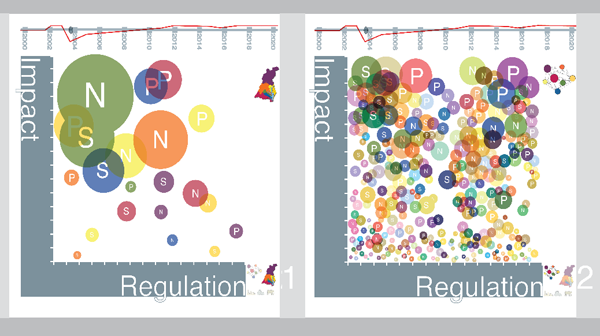
During the fall 2010 semester, UVA environmental sciences professor David Smith organized a multi-disciplinary five course and studio cluster on the Chesapeake Bay watershed: architecture (taught by Bill Sherman and Eric Field), commerce and graduate business (Mark White), systems integration (Gerry Learmonth), law (Leon Szeptycki), and environmental sciences (Smith).
Once each week these courses met together, as one large multi-disciplinary class, to play the UVA Bay Game and explore the interrelation of topics and methods in each of the separate courses. Faculty members used game development as an opportunity for student research: Learmonth’s systems integration class (working with Allison Leach, UVA environmental sciences professor Jim Galloway’s research assistant) built an airshed module; Field’s visualization of information studio redesigned the user interface; and Smith’s environmental sciences class prepared supplemental materials on each stakeholder role and Bay ecology.
These multi-class gameplays yielded the first systematic data on player decision-making, particularly on the relation of communication among players and the formation of player groups. Education school professor David Feldon and his PhD student Jennifer Elliott used this data to test and refine novel learning assessment tools developed especially for complex systems simulations.
For the faculty team the UVA Bay Game serves as a shared teaching laboratory: it enables new educational procedures, and its continuous revision affords distinctive learning opportunities for faculty and students alike.
2010 University User Group
In December 2010 the UVA Bay Game team invited colleagues at regional higher education institutions to join in establishing a user consortium to accelerate game development for wide dissemination. Following planning meetings in early 2011 the user consortium decided to conduct a bold experiment in inter-institutional education by conducting a 7 university gameplay on Earth Day 2011. In the 2011-12 academic year the user consortium continued to test the UVA Bay Game in a wide range of courses and class formats and use gameplay data to refine learning assessment tools.
K-12
In November 2010 the UVA Bay Game and partner Azure Worldwide keynoted the annual Virginia Ed Tech Workshop in Roanoke, VA with more than 500 K-12 teachers and conducted a gameplay. In January Tammy McGraw (Director, Educational Technology, Virginia Department of Education) and Cheri Kelleher (Program Coordinator, Virtual Virginia) selected a 150-student advanced placement environmental sciences class offered on the Virtual Virginia platform for a K-12 test. In March Colleen Spinelli and Tara Farr conducted a two-week gameplay to demonstrate the feasibility of using the UVA Bay Game in virtual classrooms with asynchronous teacher-student interaction.
Eric Field, one of the game's lead developers, also took the game "home" to his own children's classrooms. Working with local teachers at Stone-Robinson Elementary in Albemarle County, Virginia, he ran a gameplay for the entire 5th grade of students (including his own daughters) who were studying watersheds as part of the State of Virginia Standards of Learning. Three teachers played the regulator roles. Students played the rest. The 5th graders during this gameplay understood the watershed and its complex tradeoffs as well as any adult, including participants in other gameplays at the AAAS, the US House of Representative staff, the NOAA Games and Simulation Summitt, and numerous university classrooms. One 5th grader got up during the game to run over to the teachers: "Stop messing with my incentives!!!". I think we can call this a success.
Middle School, High School, and University classrooms from across the region and the United States continue to use and show new interest in the game. Contact us.